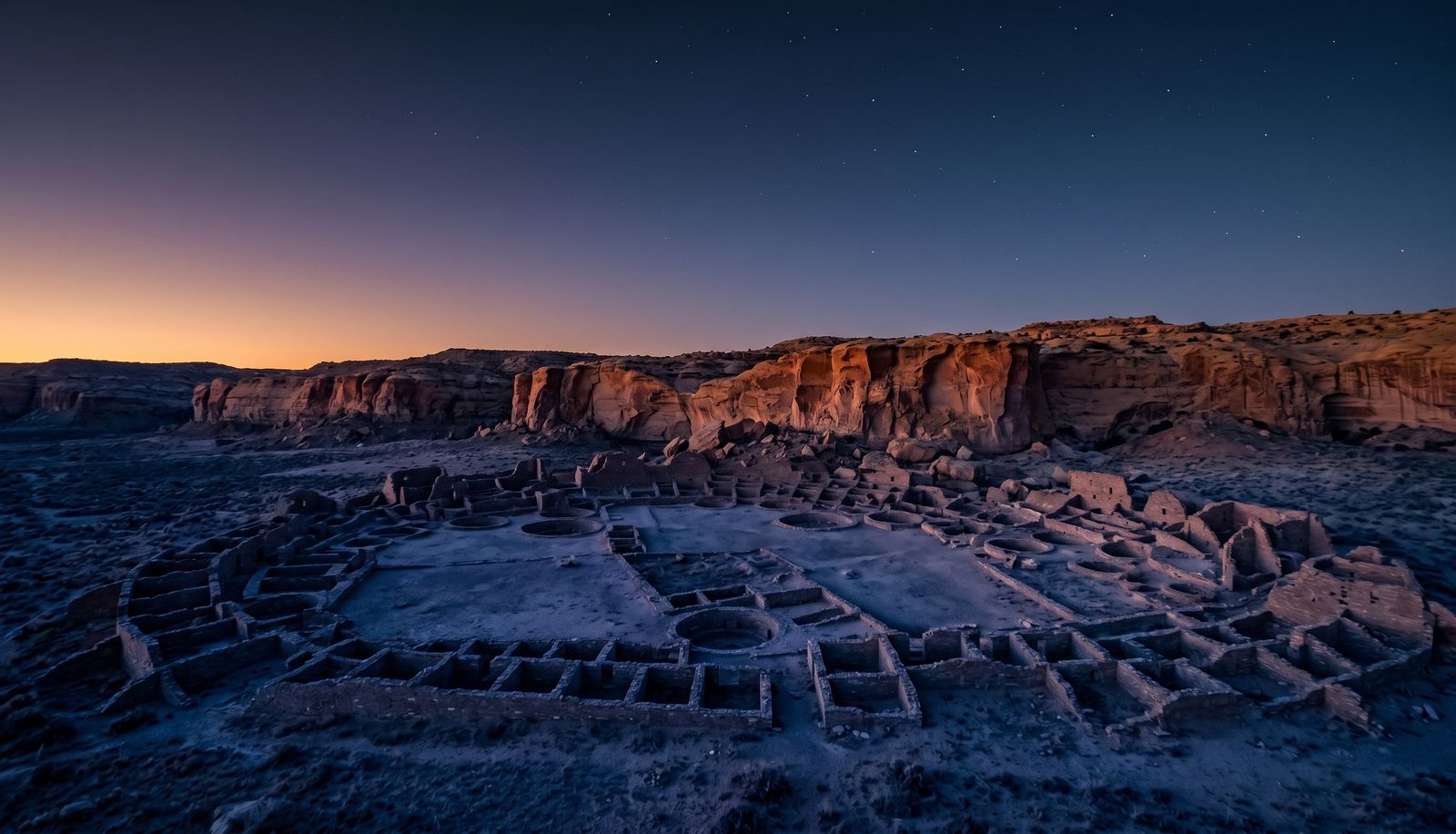
A thousand years ago somebody built a stone complex of six hundred rooms in a desert canyon and aligned parts of it to the sun and the moon. Getting there is still difficult, which is why it is empty.
There is a version of America that British travellers have in their heads, assembled from films, and New Mexico is not in it.
The northwest corner of the state is high desert — around two thousand metres, dry, cold at night, enormous. In a shallow canyon in the middle of it there is a complex of stone buildings that was the centre of a civilisation for roughly three hundred years, and which has been largely empty for eight hundred.
It is a UNESCO World Heritage site. It is also one of the least convenient major archaeological sites in the developed world to reach, and those two facts are directly related to why standing there feels the way it does.
What was here
Between roughly the ninth and twelfth centuries, Ancestral Puebloan people built a series of very large stone structures in and around this canyon. The largest, Pueblo Bonito, contained several hundred rooms across multiple storeys and was for a long time the biggest building in North America.
These were not villages in the ordinary sense. The scale is wrong for it, the number of hearths is wrong for it, and the buildings are connected across the wider region by a network of engineered roads running for tens of miles in straight lines. What Chaco actually was — ceremonial centre, administrative capital, redistribution hub, something we do not have a word for — is still argued about, and the arguing is part of the interest.
A note on how to write and think about this place: it is not a ruin in the sense of an abandoned curiosity. It remains significant to Pueblo, Hopi and Navajo people today, and it is treated as such by the people who manage it. Visit accordingly.
The alignments
Parts of the complex are oriented to solar and lunar events with an accuracy that is difficult to explain as coincidence. Certain walls align to the cardinal directions. Certain sight lines mark solstice positions. The most famous feature, a spiral petroglyph on a butte within the park where slabs of rock admit daggers of light across it at key points in the year, is no longer accessible to visitors and has been damaged by ground disturbance since its documentation.
What you can do is be there at a solstice or an equinox, when the park generally runs programmes, and the alignments become visible rather than theoretical.
The night sky
Chaco holds a dark sky designation, and the darkness here is of a quality most British visitors will not have experienced. There is no significant settlement for a long way in any direction, and the elevation and the dryness do the rest.
The Milky Way is not a smudge here. It has structure, and it casts enough light to walk by once your eyes adjust, which takes far longer than people expect — give it a full thirty minutes and do not look at a phone during them.
The park has an observatory and runs night programmes seasonally. Whether or not you catch one, the combination of standing among thousand-year-old buildings that were oriented to the sky, under that sky, in silence, is the reason to come.
The road, which is the actual issue
The park is reached by unpaved road. This is not incidental — it is the single thing that most determines whether a visit works.
The surface varies from acceptable to genuinely bad depending on when it was last graded and how recently it has rained. Wet conditions turn parts of it to a clay that ordinary vehicles struggle with, and there is no service of any kind once you commit to it.
WHAT TO SORT OUT BEFORE YOU DRIVE IN
Check road conditions with the park on the day. Not the day before. This is the standard advice from everyone who manages or visits the place and it is not excessive caution.
Arrive with a full tank, water, and food. There is no fuel and no shop inside the park, and the nearest towns are a long way back.
Tell someone where you are going and when you expect to be out. You will have no phone signal for the duration.
Do not plan to arrive in the dark on your first visit. The road is difficult enough in daylight.
Staying, and staying up
There is a campground inside the park and effectively nothing else. If you want to be there at night — and being there at night is the whole point — you either camp or you drive the road twice in the dark, which is not a serious option.
Book ahead where booking is possible, and be prepared for genuine cold after sunset regardless of the daytime temperature. High desert loses heat the moment the sun goes.
What else is out there
The wider region rewards a slower trip. There are other Ancestral Puebloan sites within reasonable driving distance, an extraordinary badlands wilderness of eroded rock formations to the north, and the drive between any two points is itself the experience — long, empty, and quite unlike anything in Europe.
If you have come this far, do not do Chaco as a day trip from somewhere comfortable. Give the region four or five days.
Staying connected, honestly
There is no signal at Chaco, and there is none on much of the road in. This is not a coverage gap that a different plan or a different provider fixes. There are no masts out there, because there is nobody out there.
Plan for it as a certainty rather than a possibility. Download maps and the route before you leave the last town. Screenshot the directions, because a saved image works when a map that needs to load does not. Tell somebody your plan.
And then, honestly, enjoy it. Two nights genuinely off the network in a place that dark is rarer than it used to be, and it is a considerable part of why the visit stays with people.
The list, which here is not optional
Everything on this one is about being self-sufficient, because no amount of preparation on the phone helps once you are past the last mast.
A full tank before you turn off the paved road. There is no fuel in the park.
Water and food for longer than you plan to stay. There is no shop.
Maps and directions downloaded, and then screenshotted. A saved image opens when a map that needs to load does not.
Road conditions checked with the park on the day, not the day before.
Somebody who knows your plan and when you expect to be out.
Warm clothing regardless of the daytime temperature. High desert loses its heat the moment the sun goes down.
Before you go
Do not do Chaco as a day trip from somewhere comfortable. The road takes what it takes at both ends, and the whole reason to be there is the part that happens after dark. Camp, or do not go.
Give the wider region four or five days if you can. There are other Ancestral Puebloan sites within driving distance, an extraordinary badlands wilderness to the north, and the driving between any two points is itself the thing — long, empty, and quite unlike anywhere in Europe.
And be honest with yourself about the vehicle and the weather. The unpaved access varies from acceptable to genuinely difficult depending on grading and rain, and there is no assistance out there. People do get stuck. It is not a reason to stay away; it is a reason to arrive prepared and unhurried.