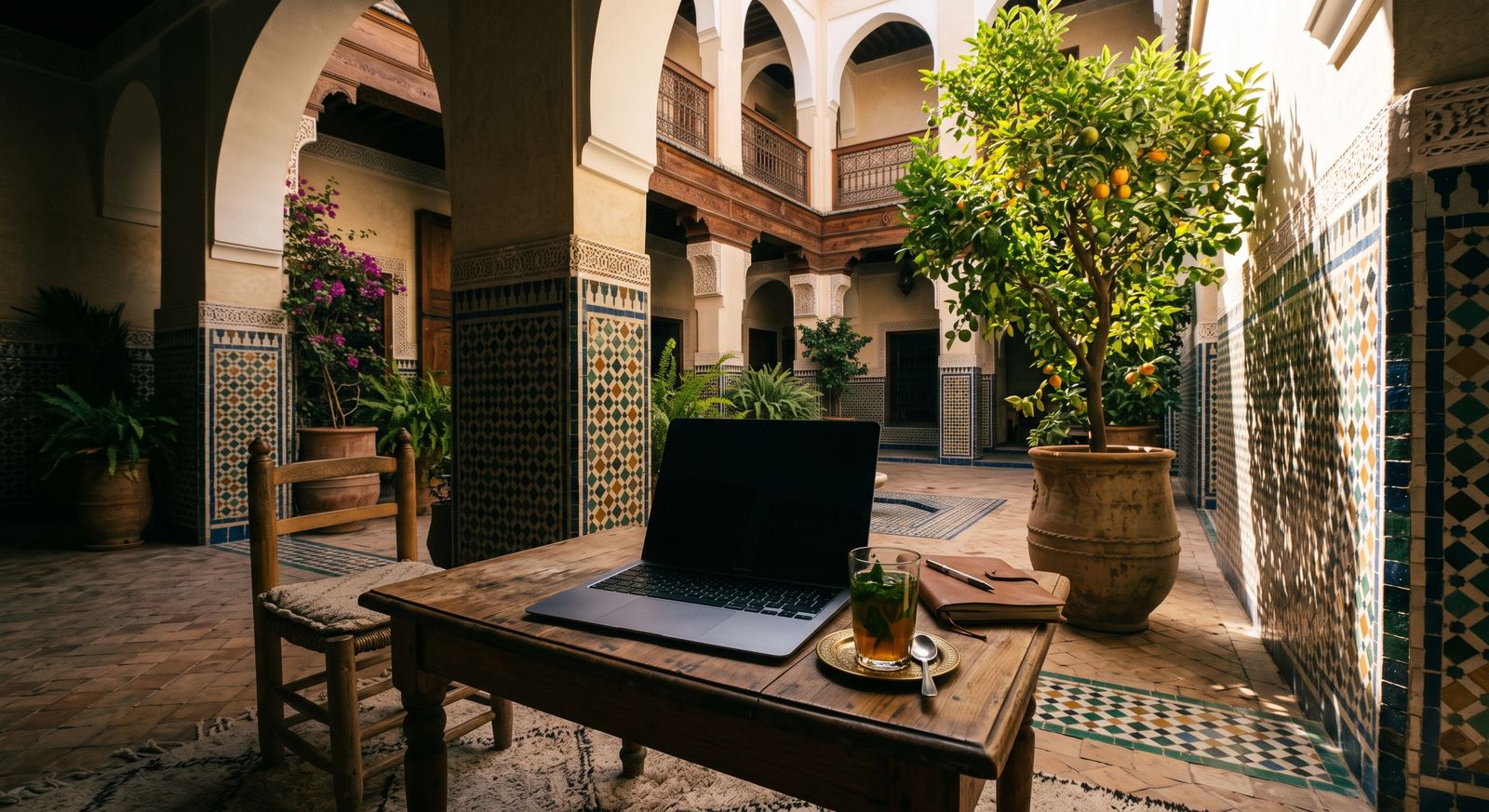
Riad Wi-Fi is charming in the same way the plumbing is charming. Plan your working month around what it cannot do.
Morocco has become a serious remote-work destination for people in European time zones, and Marrakech is where most of them start. It is three hours from London, the winter climate is the argument, and the cost of a month there is a fraction of the equivalent in southern Europe.
The connectivity picture is better than its reputation and worse than you need, which is a specific and manageable combination.
The riad Wi-Fi problem
Traditional riads are thick-walled buildings arranged around a courtyard, frequently several centuries old. They are wonderful to stay in and they are close to the worst possible shape for a wireless network. A single router in a stone building with a courtyard in the middle produces good signal in one room and very little two doors away.
This is not a Moroccan problem — it is a masonry problem, and it applies to old buildings anywhere. It matters more here because riads are the reason people come.
The practical effect: the Wi-Fi is genuinely fine in the room where the router is, adequate in the courtyard, and unusable on the roof terrace where you actually wanted to work.
What a working month needs
Be specific about this rather than guessing, because the answer varies enormously by job.
Email, documents, messaging: trivial. Any connection handles it, including a weak one.
Video calls: the deciding factor. They need both capacity and stability, and stability is what old buildings take away. A dropped call in a client meeting is a different order of problem from a slow page load.
Cloud file sync: heavy and continuous, and it runs in the background whether you are thinking about it or not.
Anything involving large uploads: design files, video, photography. If this is your work, plan around it explicitly rather than hoping.
For most people the pattern that works is Wi-Fi for the bulk of the day and a mobile plan for the things that must not fail — which usually means the calls.
THE ARRANGEMENT MOST PEOPLE END UP WITH
Work on the riad Wi-Fi. Take calls tethered to your phone.
It sounds like a compromise and it is actually just the sensible allocation: the fixed connection carries the heavy background traffic, and the mobile connection carries the thing where reliability matters more than volume.
Test it in the first two days rather than discovering it during a call that matters.
Beyond the city
Coverage in Marrakech, Casablanca, Rabat and the main tourist towns is good. It thins as you head into the Atlas, and in the mountain valleys and desert areas it becomes intermittent or absent.
If your month includes a few days in the mountains — and it should — treat those days as offline days and plan the work around them.
Sizing the plan
A month of the arrangement above — Wi-Fi for the bulk, mobile for calls and the gaps — sits comfortably inside a long-stay plan for most people. A month where the mobile plan carries the full working day is a different calculation, and belongs at the top of the ladder.
Our long-stay Morocco plans run to 100GB over 90 days starting at $77.90. Buying one plan for the period costs less per gigabyte than renewing monthly, and there is nothing to remember halfway through.
The practical set-up
Set it up at home before you fly. Your UK number stays on the phone, which matters over a month — banks and verification codes still arrive where they always have.
And test the tethering arrangement on day one, in the place you intend to work, at the time of day you intend to work. Not on the morning of the first call that matters.