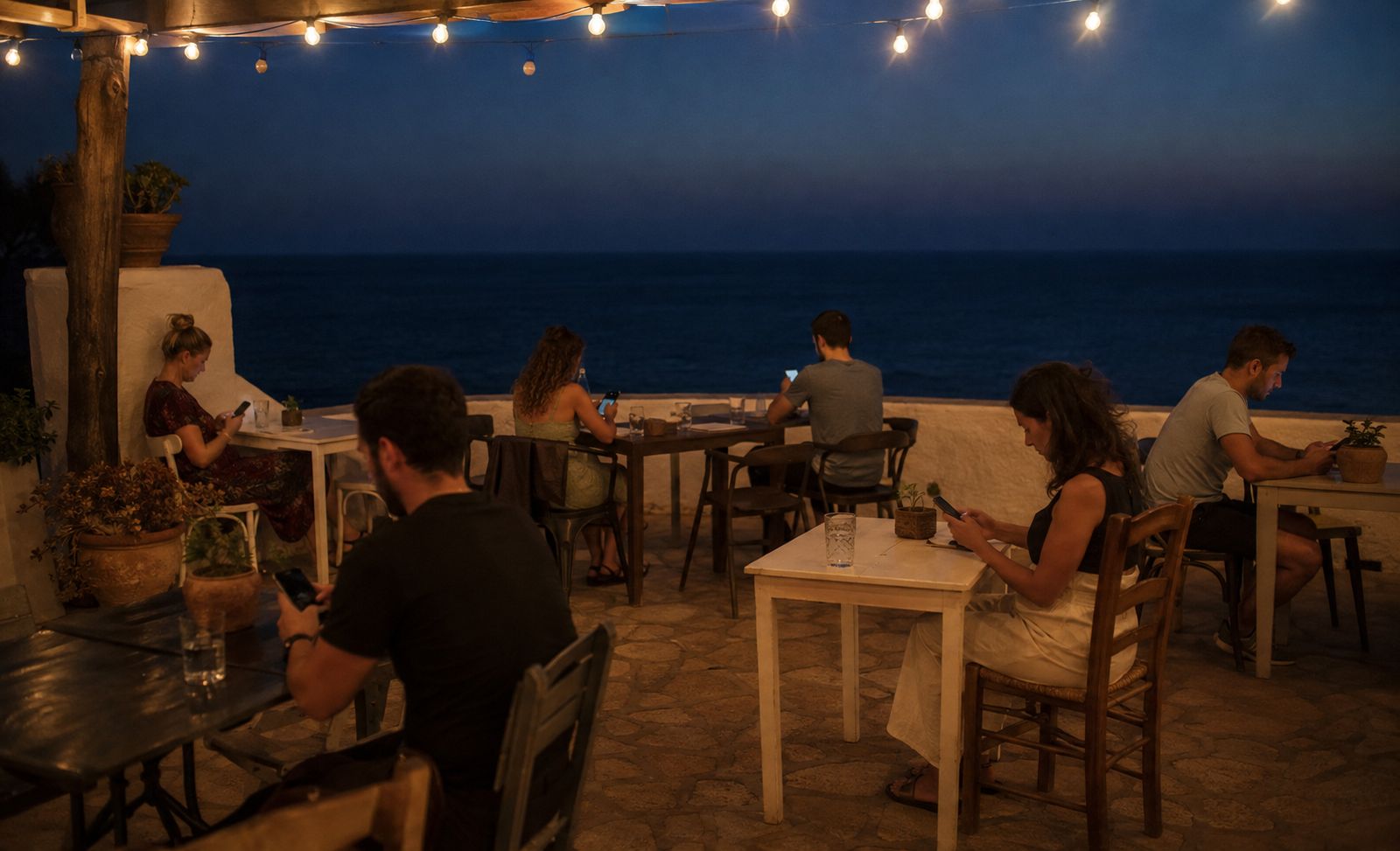
It is not the hotel being cheap and it is not your phone. It is four hundred people deciding to video-call home at the same time.
There is a moment on most Greek resort holidays, usually somewhere around eight in the evening, when the Wi-Fi stops being Wi-Fi. Pages hang. A video call drops twice and then refuses. The photographs you set uploading at dinner are still uploading at midnight.
By eleven it works again, and by breakfast it is fine. Then it happens again the next night.
This is not a fault, and complaining at reception will not fix it, because nothing is broken.
What is actually happening
A hotel has one connection to the outside world, and everyone in the building shares it. That connection is sized for normal use spread across a day, not for the moment when a large proportion of the guests are online simultaneously doing the heaviest things they do all day.
Evening is that moment, and it is remarkably consistent. Dinner ends, people sit down, and within about half an hour the same three activities begin across the whole property: uploading the day’s photographs, video-calling home, and streaming something.
Those are the three heaviest ordinary things a phone does. Multiply them by several hundred rooms and the shared connection runs out of capacity. Everything continues to work in the sense that packets are still moving, just very slowly.
Why it is worse in Greece than in some places
Three reasons, none of them anybody’s fault.
Island infrastructure. A hotel on a small island is at the end of a longer and thinner chain than a hotel in a city. The connection reaching the building is often genuinely smaller.
Seasonality. A property with four hundred guests in August and forty in April is provisioned somewhere in between, because paying year-round for August capacity is not viable.
The building. Old stone, thick walls, and rooms arranged around courtyards defeat wireless signal indoors regardless of how good the connection reaching the building is. Your room may be poor while the lobby is fine.
THE TEST THAT TELLS YOU WHICH PROBLEM YOU HAVE
Stand in the lobby or by the router and try again. If it works there and not in your room, it is a coverage problem inside the building. Ask whether there is a closer access point, or move.
If it is equally slow everywhere, it is congestion, and no amount of moving will help. That is the evening problem, and the only real answers are to wait or to use a different connection entirely.
What still works when it is congested
Worth knowing, because it changes what you attempt rather than what you complain about.
Text messaging works throughout. It needs almost nothing.
Voice calls over the internet usually hold up better than video, because audio needs a fraction of what video does. Turning the camera off often rescues a failing call.
Loading a web page works, slowly.
Uploading photographs effectively stops. So does anything streaming in high quality.
The things that cost nothing
Most of the fix is timing rather than equipment.
Upload in the morning. Set photo backup to run while you are at breakfast. The connection is close to empty at eight in the morning and close to saturated at eight in the evening, and the difference is enormous.
Download in the afternoon. Whatever you want to watch tonight, get it during the quiet hours.
Audio, not video, for the evening call home. It works when video does not.
Ask which end of the building the router is at. Reception knows, and a room forty metres closer changes the indoor picture completely.
When a mobile connection helps, and when it does not
A mobile connection does not share the hotel’s bottleneck, so it is genuinely useful for the evening video call, or for the moment you need something to work and the Wi-Fi will not.
It is not the answer for volume. Backing up a week of photographs over mobile data works and consumes a great deal; the hotel connection at eight in the morning does the same job for nothing. Use the fixed connection for weight and the mobile one for the things that must not fail.
That allocation, rather than a bigger plan, is what actually solves the evening.
One honest limitation, since Greek holidays involve boats
Almost every Greek trip includes at least one boat: a day excursion to a nearby island, a caldera cruise, a ferry transfer.
Our plans work on local mobile networks. Not at sea or in the air. Once a boat is far enough from shore there is nothing on land for it to connect to, and the same is true of anything else that relies on land masts.
Worth knowing for two reasons. Plan the day assuming you will be offline for the crossing, which is easily done and mostly pleasant. And be aware that if your phone finds a ship’s own onboard network, that is a separate operator with its own charges, billed through your home network rather than through us — turning mobile data off before you leave port avoids the whole question.
Coverage on the islands generally
Good in the towns, ports and resort areas where visitors spend nearly all of their time. Thinner in the interiors, on cliff paths and on the smaller and less populated islands, in the same way rural coverage thins anywhere.
For a standard resort holiday you will not notice a problem. For a walking holiday in the interior of a small island, download the map.
Setting up
Before you fly, at home, on your own Wi-Fi — not on the hotel connection at eight in the evening, which is the entire subject of this article.